

Relationship OCD (ROCD): Signs, Causes, and How to Quiet Relentless Doubt

Key Takeaways
- The Core Issue: Relationship OCD (ROCD) causes intrusive, distressing doubts about your partner, feelings, or compatibility.
- The Trap: Compulsions like checking feelings, comparing partners, or seeking reassurance offer only brief relief before anxiety returns stronger.
- ROCD vs. Reality: Unlike steady relationship concerns, ROCD doubts feel urgent, frantic, and never satisfied, even when things are going well.
- Finding Support: An experienced therapist can help you make sense of obsessive doubt and develop more helpful ways of responding to uncertainty. Working integratively, they can draw on different therapeutic approaches to suit your needs and experiences. If ROCD is affecting your relationship, couples counselling can offer space to understand its impact and work through difficulties together.
Relationship OCD (ROCD) can leave you lying awake at night, mentally reviewing your relationship, asking yourself whether the feeling is still there. Perhaps your partner reassures you and, for a couple hours, you feel better, only for the doubt to return the next morning. You might look at other couples and wonder why they seem so certain whilst you remain constantly interrogating your own heart.
ROCD is a presentation of obsessive-compulsive disorder (OCD) in which intrusive doubts about your relationship, your feelings or your partner become caught in a distressing cycle of anxiety and compulsive attempts to find certainty. With appropriate support, the cycle can become less intense and easier to manage.1,2
In this guide, we’ll explore what ROCD can look like, common obsessions and compulsions, why reassurance can make the cycle stronger, how to distinguish obsessive doubt from ordinary relationship uncertainty, and how therapy can help.
What Is Relationship OCD (ROCD)?
Relationship OCD (ROCD) is a form of OCD in which intrusive doubts about a romantic relationship, a partner or your own feelings can cause significant distress, prompting repeated efforts to gain certainty through checking, analysing, comparing or searching for reassurance.1,2
Having doubts about a relationship does not automatically mean you have ROCD. Uncertainty is a normal part of relationships. Feelings and attraction can fluctuate, and even people in loving relationships sometimes question their compatibility or future together.
With ROCD, however, the doubt can feel relentless. Instead of appearing occasionally and passing, a question can become something you feel compelled to solve.
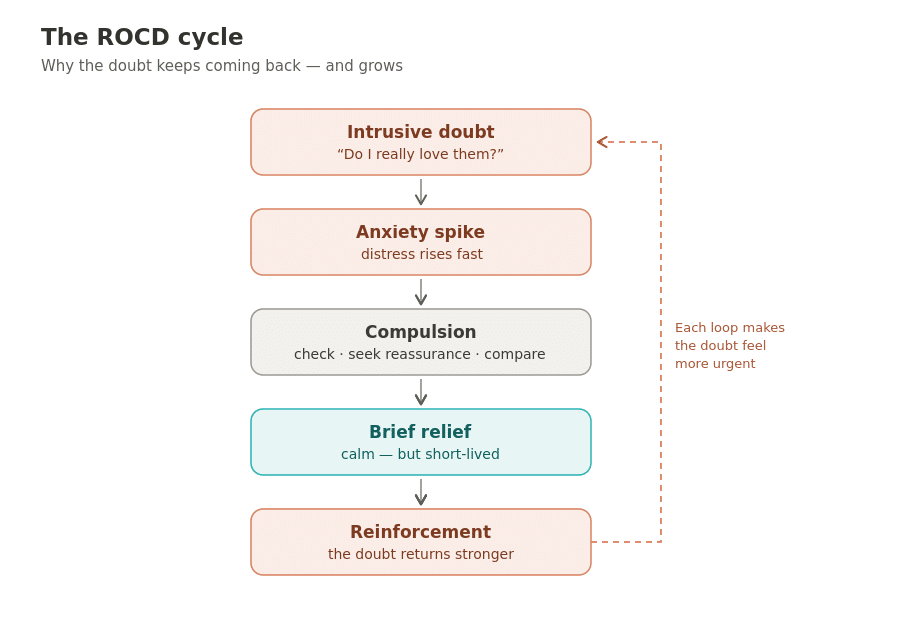
The cycle can often look something like this:
Intrusive doubt → anxiety → compulsion → temporary relief → doubt returns
You might think, “What if I don’t really love my partner?” Anxiety rises, so you begin analysing how you felt on your last date, checking whether you miss them while they are away, comparing your relationship with others or asking a friend for reassurance.
This may bring temporary relief, but responding to the doubt in this way can reinforce the sense that it needs your attention. When it returns, you feel compelled to investigate it again and the cycle begins again.1,2
The Two Types of ROCD
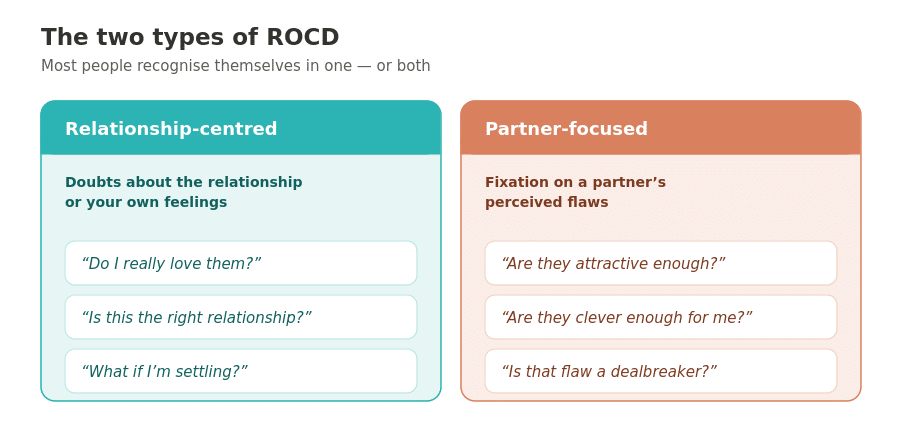
Two common patterns of ROCD are relationship-centred and partner-focused obsessive doubts. You may recognise one more strongly than the other, or experience elements of both.1,2
Relationship-Centred ROCD
Relationship-centred doubts focus on the relationship itself or your own feelings towards your partner.
You might find yourself repeatedly asking:
“Do I really love them?”
“Am I attracted to them enough?”
“Is this the right relationship?”
“What if I’m settling?”
“Shouldn’t I feel more certain than this?”
For example, you might feel less affectionate towards your partner when you wake up than you did the day before and immediately wonder what it means. Rather than accepting that feelings naturally fluctuate, you may start questioning what the perceived change says about your relationship.
Partner-Focused ROCD
Partner-focused doubts become attached to perceived characteristics or “flaws” in your partner.
You might become preoccupied with their appearance, intelligence, personality, success, social skills or morality. Something you barely noticed before can suddenly feel enormously significant.
You might then experience shame or guilt for having those thoughts about someone you care about, which can add another layer of distress: “If I really loved them, surely I wouldn’t be thinking this.”
Both patterns can feed the same underlying search for certainty.1,2
Signs of ROCD: Common Obsessions and Compulsions
ROCD can be difficult to recognise because the doubts often resemble questions that can come up in any relationship, and they centre on something that genuinely matters to you. This can make them feel especially important to answer. With ROCD, however, these questions can become repetitive and distressing, leaving you feeling compelled to resolve them and caught in an obsessive-compulsive cycle.1,2
Common obsessions (the thoughts)
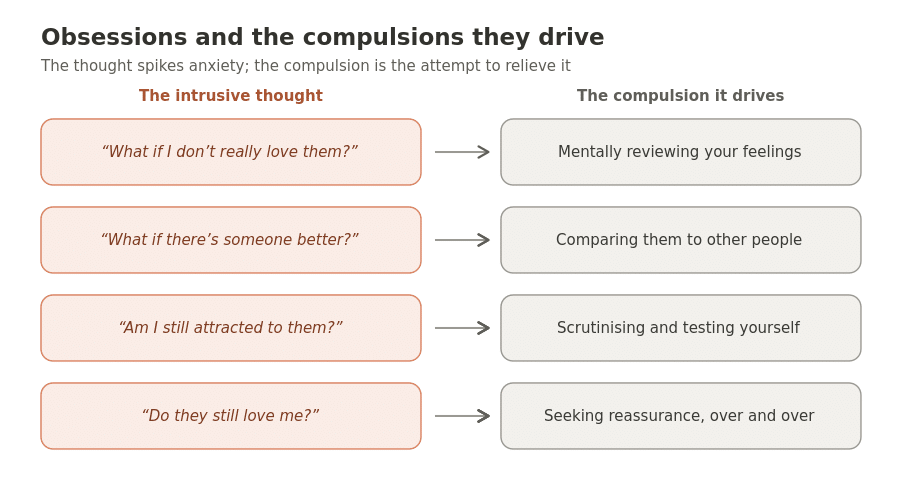
ROCD obsessions may include recurring questions such as:
- Do I love my partner enough?
- What if there is someone better for me?
- Am I still attracted to them?
- What if I’m making a terrible mistake?
- What if I regret staying, or leaving?
- Why don’t I feel the “spark” right now?
- What if this particular flaw means we’re incompatible?
The exact thought matters less than the urgent feeling that you need to work it out.
Common compulsions (what people do to cope)
A compulsion is an attempt to reduce the anxiety or uncertainty created by an obsession. Many ROCD compulsions can be subtle, happening entirely inside your own head.1,2,4
You might:
- mentally review conversations, dates or moments of intimacy
- analyse your feelings or check for attraction and a “spark”
- seek reassurance from your partner, friends or family
- compare your partner or relationship with ex-partners, other people or other couples
- “test” your feelings or attraction to people you see online or in everyday life
- search online for answers, confess intrusive thoughts or avoid situations that trigger doubt.
These behaviours can reduce anxiety temporarily. The problem is that temporary relief can reinforce the idea that the thought required a response in the first place.1,2
Is It ROCD, or Am I in the Wrong Relationship?
For many people with ROCD, one question can feel especially difficult to answer:
“Is this ROCD, or am I having doubts because I’m in the wrong relationship?”
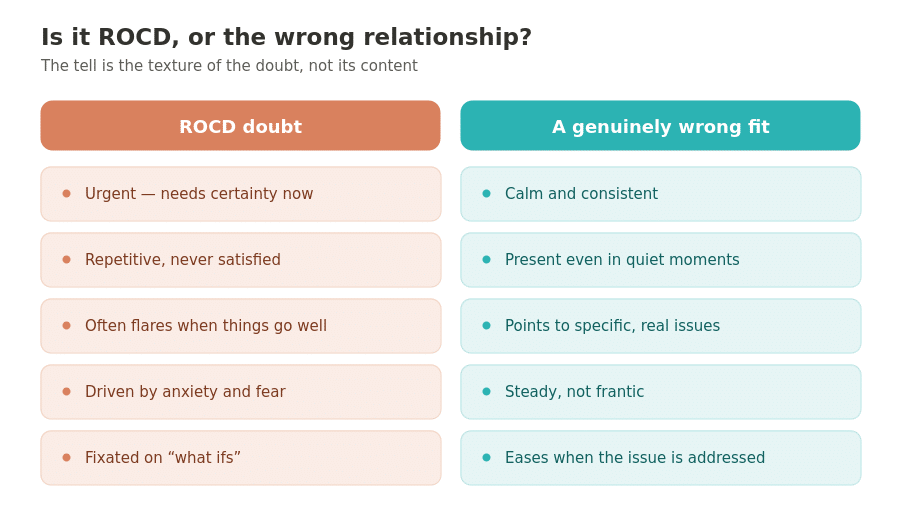
There is no simple test. People with ROCD can have genuine relationship concerns, and people without ROCD can experience doubt. What can be helpful is noticing what happens whenever doubt appears.
With ROCD, doubts often feel urgent and difficult to leave unresolved. You may analyse your feelings, check your attraction or seek reassurance, only to find that any relief is short-lived. Even a happy weekend together can trigger more questions:
“Was I happy enough? If this were really right, wouldn’t I feel more certain?”
Real relationship concerns can exist too, with or without ROCD. These could include differences in values, unmet needs, crossed boundaries or concerns about how you are treated. ROCD can make these harder to consider calmly because of the need for certainty.
The goal of overcoming ROCD is not to find a foolproof answer to “Is this the right relationship?” Trying to determine with certainty whether a doubt is “ROCD or real” can itself become part of the obsessive-compulsive cycle.
No article can tell you whether you should stay or leave. Therapy can help you recognise obsessive patterns, explore genuine concerns, and make choices without needing absolute certainty first.
What Causes ROCD?
There is no one simple cause of ROCD, and experiencing it does not necessarily mean there is something wrong with your relationship.
You may be more vulnerable to ROCD if you already struggle with anxiety or obsessive thinking, particularly if uncertainty feels difficult to tolerate. Perfectionism and self-doubt can add to this. Earlier experiences, such as relationships in which affection, consolation or emotional support felt inconsistent, may likewise influence how secure you feel in close relationships later in life.
Perfectionism and the search for “the one”
If you believe the right relationship should always feel certain, passionate and effortless, the natural ups and downs of being with someone can start to feel like signs that something is wrong.
For someone with ROCD, this can create an impossible search for the “perfect” relationship. A quieter day, a disagreement or a moment when you feel less connected can become something to analyse: “Would I feel this way if they were really the one?”
But no relationship feels perfect all the time. Feelings change, attraction can ebb and flow, and even happy couples have periods when they feel less connected.
Accepting this doesn’t mean lowering your standards or overlooking genuine problems. It means allowing a good relationship to be imperfect without treating every change in feeling as evidence that it must be wrong.
How culture and media can amplify the doubt
Movies, social media, books and dating shows can create powerful expectations about how love should look and feel: effortless, exciting and certain.
These messages don’t necessarily cause ROCD, but they can give obsessive doubt more to latch onto.
A seemingly perfect couple online might leave you wondering, “Why don’t we look that happy?” while a romantic film might prompt, “Why don’t I feel that intensely about my partner?”
It’s an unfair comparison: you’re measuring the full, complicated reality of your own relationship against a deliberately curated image or fictional version of love.
Why Reassurance and Checking Make It Worse
When ROCD feeds uncertainty, it’s understandable to want reassurance. The problem is that the relief from checking, analysing or asking others for answers rarely lasts.3,4
The reassurance trap
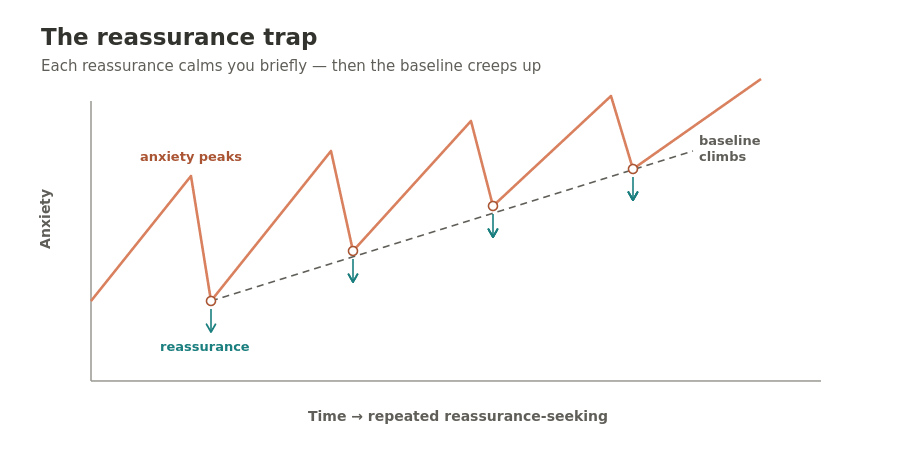
You might ask your partner what they think, talk your worries through with a friend or search online for answers. You may feel relief for a while, but then another doubt appears: “What if they only said that to make me feel better?” or “What if I didn’t explain it properly?”
So you seek reassurance again. Over time, you can become caught in a compulsive cycle of doubt, reassurance and short-lived relief. As the cycle repeats, your baseline anxiety can gradually rise, making uncertainty increasingly difficult to sit with and reinforcing the reassurance seeking compulsion.3
The feeling-checking paradox
You might also find yourself repeatedly checking how you feel around your partner: “Do I feel love right now?” or “Was that kiss exciting enough?” 1,2,4
The problem is that repeatedly monitoring your feelings may not give you the certainty you’re looking for. Instead, you can become increasingly focused on whether you feel enough love, attraction or excitement, leading to more checking when uncertainty remains.1,2,4
If you find yourself reading article after article hoping the next one will finally give you an answer, gently notice what you’re looking for. Are you looking for helpful information, or reassurance that will make the uncertainty go away?
How Therapy Can Help with ROCD
ROCD can feel overwhelming, particularly when it centres on a relationship that matters deeply to you. Talking therapy can help you understand what keeps the cycle going and respond differently when doubts arise. A therapist working integratively can draw on different therapeutic approaches to suit your needs, experiences and relationship context.
The aim isn’t to convince you that your relationship is definitely right or to make uncomfortable thoughts disappear. It’s about becoming less caught up in the need for certainty.
Understanding the Cycle and Responding Differently
Part of the work may involve noticing when checking, analysing or seeking reassurance brings brief relief but keeps the doubt going. Together, you and your therapist can explore ways to respond with greater flexibility, at a pace that feels manageable.
For someone with ROCD, that could mean noticing a thought such as “Maybe this isn’t the right relationship” and practising leaving it unanswered, rather than immediately analysing feelings, comparing partners or seeking reassurance.
This does not mean agreeing with the thought or ignoring a genuine concern, but gradually learning that uncertainty can be present without every doubt needing an immediate response. As part of an integrative approach, your therapist may draw on Exposure and Response Prevention (ERP) to help you practise experiencing uncertainty or intrusive thoughts without relying on compulsive responses for temporary relief.5
Making Space for Thoughts, Feelings and What Matters to You
With ROCD, intrusive thoughts about your relationship can begin to shape how you feel and behave. Therapy can help you explore your responses to these thoughts and the feelings they bring up, without automatically treating them as facts or problems that must be solved.
The work can also involve reconnecting with your values, understanding what matters to you and how you want to live. Rather than waiting to feel completely certain, you might begin to ask: “How do I want to show up in my relationship, even when uncertainty is present?” An integrative therapist may draw on ideas from Acceptance and Commitment Therapy (ACT) to support this.6,7
There can also be space to explore how your relationship history, expectations and emotional needs influence your experience of closeness and doubt, alongside the patterns that keep the ROCD cycle going.
Mindfulness may help you return your attention to the present when repeated “what if?” questions take over. The balance of reflection and practical work can develop collaboratively as you and your therapist understand what is helpful for you.
If Your Partner Has ROCD
ROCD can also be painful for the person on the receiving end.
If your partner repeatedly questions whether they love you, asks whether you love them, compares you with others, or scrutinises aspects of your appearance, personality or compatibility, you may understandably feel hurt, exhausted or insecure.
Your instinct may be to reassure them: “Of course we’re right for each other,” or explain why their fears are unfounded. Compassion matters, but repeatedly providing certainty can unintentionally become part of the ROCD cycle.3,4
Supporting your partner can mean being warm and present without repeatedly answering the obsession:
“I can see how anxious this is making you, but I don’t think going through the same question again will help.”
Supporting your partner in seeking help from an experienced therapist can be valuable. An integrative approach can draw on an understanding of obsessive-compulsive patterns while taking account of individual needs and experiences. If ROCD is affecting communication, intimacy or trust, couples counselling can offer space for both partners to understand its impact and work through difficulties together, without becoming another way to seek certainty about whether the relationship is “right.”
Supporting your partner doesn’t mean overlooking your own wellbeing. You can set boundaries around repeated reassurance, questioning or “testing” while still responding with care.
Finding Support for Relationship OCD
When you find yourself repeatedly pulled into the cycles of ROCD, it can feel as though peace is waiting on the other side of one final answer. If you could only know whether you love your partner enough, if they’re attractive enough, whether someone better for you is out there or whether the relationship is truly right, you could finally relax.
But the search for certainty can be what keeps you stuck.
Learning to recognise the obsessive-compulsive cycle, respond differently to intrusive thoughts and make room for the uncertainty that exists in every relationship can gradually help loosen its grip.
You do not need to feel completely certain about your relationship, or have perfect feelings about your partner, before you can engage fully with your life.
With the right support, it is possible to step out of the cycle of doubt, checking and reassurance. A therapist who understands relationship obsessive-compulsive difficulties can help you recognise these patterns, explore your feelings and relationship concerns, and develop ways to respond to doubt without repeatedly trying to resolve it. Working integratively means drawing on relevant therapeutic knowledge and interventions in a way that fits you, whether you attend individually or as a couple.
Over time, doubts can take up less space, leaving you freer to engage with your relationship and make choices based on what matters to you, rather than the need to feel completely certain.
FAQs
Is ROCD a real disorder?
ROCD describes a recognised presentation of Obsessive Compulsive Disorder (OCD) in which obsessions and compulsions focus on your relationship, your partner or your feelings towards them. These doubts can become repetitive and distressing, leading you to analyse, check, compare or repeatedly seek reassurance. It is more than simply being “too picky” or indecisive.1,2
Does ROCD go away?
ROCD can improve with appropriate support. Talking therapy with a therapist who understands obsessive-compulsive patterns can help you explore what keeps the cycle going and practise responding differently to doubt. Depending on your needs, the work may draw on approaches such as Exposure and Response Prevention (ERP), which can help reduce checking, analysing and reassurance-seeking. The aim isn’t to eliminate relationship doubts altogether, but to help you respond to them differently.5
Is ROCD a sign I should break up?
ROCD itself cannot tell you whether you should stay in or leave a relationship. In fact, repeatedly trying to obtain certainty about whether you “should” break up can become part of the obsessive cycle.
Therapy can help you recognise this pattern while also recognising your values, boundaries and genuine relationship concerns.
Can you have ROCD in a happy relationship?
Yes. ROCD can affect you even when your relationship is going well because the thoughts and fears associated with it do not necessarily reflect the quality of the relationship itself. Therapy can help you recognise unhelpful patterns of checking, analysing or reassurance-seeking, explore genuine relationship concerns and consider your relationship more clearly.
References:
- Doron, Derby & Szepsenwol (2014), “Relationship obsessive compulsive disorder (ROCD): A conceptual framework”
- Doron et al. (2016), “Relationship Obsessive–Compulsive Disorder: Interference, Symptoms, and Maladaptive Beliefs.”
- Salkovskis & Kobori (2015), “Reassuringly calm? Self-reported patterns of responses to reassurance seeking in obsessive compulsive disorder.”
- International OCD Foundation — Relationship OCD, by Guy Doron and Danny Derby.
- Reid et al. (2021), “Cognitive behavioural therapy with exposure and response prevention in the treatment of obsessive-compulsive disorder: A systematic review and meta-analysis of randomised controlled trials.”
- Twohig et al. (2018), “Adding acceptance and commitment therapy to exposure and response prevention for obsessive-compulsive disorder: A randomized controlled trial.”
- Nielsen et al. (2025), “Group Acceptance and Commitment Therapy versus Cognitive Behavioral Therapy/Exposure Response Prevention for Obsessive Compulsive Disorder: A Block Randomized Controlled Trial.”


