

When a relationship ends, hurt lingers, and resentment can take precedence. Ending a marriage can be messy, both emotionally and financially.
But is there another way?
Couples therapy, marriage counselling, and family therapy for separation and divorce can provide a structured space in which couples, parents and families explore these difficulties.
Therapy is not necessarily about saving the marriage or bringing a couple back together. It can also help people separate more thoughtfully, communicate more constructively and begin developing a healthier co-parenting relationship.

Subscribe to stay updated with the latest blog posts from Leone Centre.
Where legal advice is needed, therapy can work alongside it by addressing the emotional and relational difficulties that legal processes are not designed to resolve.
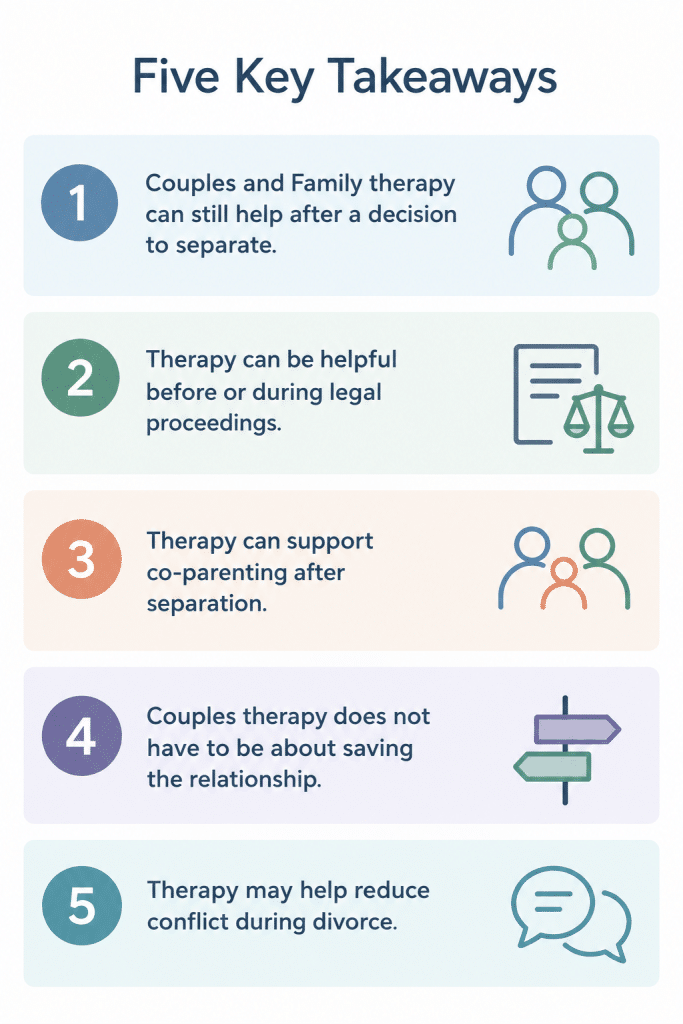
Five Key Takeaways
- Couples and Family therapy can still help after a decision to separate. Couples counselling and Family therapy can help after the decision to separate. Therapy is not only for couples who want to stay together. It can support a more considered and constructive ending.
- Therapy can be helpful before or during legal proceedings. Early therapeutic support may help prevent conflict from worsening over time. Therapy complements rather than replaces legal advice. A therapist cannot determine legal rights or financial settlements, but therapy can support the emotional and relational aspects of separation and divorce.
- Therapy can support co-parenting after separation. Therapy can help parents think about communication, boundaries, roles, and decision-making in ways that keep their children’s needs at the centre.
- Couples therapy does not have to be about saving the relationship. Therapy doesn’t necessarily need to focus on saving the relationship. Instead, it can focus on understanding the transition and finding a constructive way forward.
- Therapy may help reduce conflict during divorce. While there are no guarantees, addressing the emotional conflict early may make it easier to communicate and negotiate without every disagreement becoming a battle. Therapy can be used alongside legal advice, not instead of it
Is the Ending of a Marriage Always “Messy”?
A relationship breakdown can feel painfully absurd in many ways. A couple who once shared a home, a bank account, and perhaps the raising of their children (a couple who used to negotiate and compromise) can find themselves in a long, head-to-head battle against one another, spending thousands of pounds arguing over things that, in another context, might barely have mattered.
Each new disagreement becomes another email, another conversation with a solicitor, another negotiation. The original hurt gets translated into numbers, possessions, arrangements and positions.
And the more they spend fighting, the harder it can become to step back.
Of course, legal advice is often necessary. Separation can involve complicated questions about finances, housing, children and safety, and people need appropriate professional support to protect their interests.
But there is another question worth asking:
Before conflict escalates, what might happen if the emotional side of the relationship were addressed alongside the practical one?
Protecting our mental health is different. Statistics show that it is not necessarily the divorce itself that can produce mental health issues; it is the intensity of the conflict.
A meta-analysis of divorce outcomes observed that “psychological harm associated with divorce for both adults and children is substantially greater in high-conflict divorces than in low-conflict ones“.
What are the Emotions Beneath the Argument? (It’s Not Just About Money)
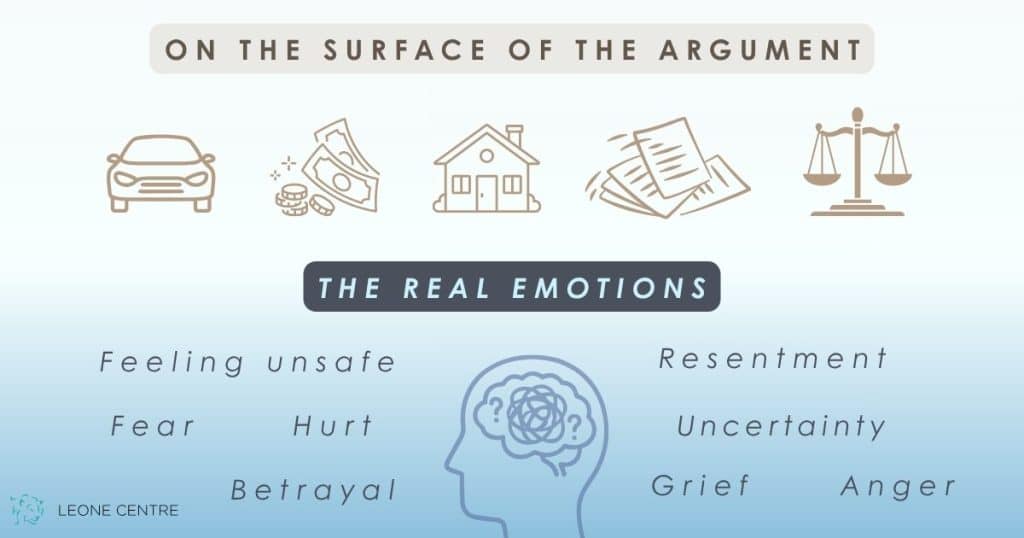
On the surface, people going through separation appear to be fighting over assets, money, or privileges.
However, if we look beneath the surface at the emotions beneath them, money often becomes a language for something else.
These arguments may truly represent:
- a need for security and safety
- fear of the future
- a desire for recognition
- an attempt to create fairness
- anger or resentment about the ending
- a struggle for control in the face of uncertainty
- mistrust
- resentment about sacrifices
- grief about the life that is ending
These are not small reasons, and they deserve time and care when you discover them.
The same can be true of disagreements about the house, possessions or parenting arrangements.
Behind “Why should they get that?” there may be “I want to feel safe”.
Behind “I’m not agreeing to that” there may be “I don’t trust them anymore”.
This doesn’t mean the practical issues don’t matter, because they do. But when emotional pain is driving the conflict, resolving the practical issue alone may not resolve the conflict itself.
Without a different way of communicating, another issue can quickly take its place.
Carlene Harvey – Therapy for Couples and Parenting

I have worked as a Relate-licensed counsellor for over 15 years and within the NHS Talking Therapies (IAPT) service, where I provided relationship counselling and Couple Therapy for Depression (CTfD) as an accredited therapist.
I have undertaken additional training in supporting individuals and couples through relationship breakdown, separation and transition. This has further developed my understanding of the emotional and practical adjustments that can accompany separation, including changes in communication, roles and relationships.
Where clients are also parents, I can support them in navigating parenting after separation and developing constructive co-parenting approaches, while recognising the wider relationship dynamics that can arise during times of transition. This broader understanding of relationship and family dynamics enables me to support clients through periods of change with sensitivity, clarity and care.
Additionally, I am an accredited Mentalization-Based Therapist (MBT) for Parenting Under Pressure, an evidence-based treatment, and I have specialised experience working within a Reducing Parental Conflict Team. This work focused on helping both intact and separated couples navigate conflict while supporting constructive communication and a parenting-focused approach.
Learn more about Carlene Harvey
Book an appointment with Carlene
Improving Communication in Therapy
Couples therapy and marriage counselling can help even when one or both partners have decided the relationship should end.

You can work with your therapist to explore questions such as:
- How can we bring this relationship to an end with dignity?
- How can we communicate without repeatedly escalating conflict?
- How will we manage the transition from one household to two?
- How can we separate without causing unnecessary emotional harm?
- How can we continue working together as parents?
- How can we protect our children from becoming caught between us?
Therapy can provide a contained, professionally supported environment for these conversations.


The Emotional and Financial Costs of Miscommunication
Legal processes provide essential protection, advice and formal arrangements when agreement cannot be reached. However, they cannot, on their own, resolve grief, betrayal, resentment or entrenched patterns of communication.
When two people are deeply hurt, even relatively straightforward decisions can become difficult. Positions harden, communication deteriorates, and the emotional and financial costs grow.
The money spent sustaining conflict could be money that could otherwise have:
- supported two households during a difficult transition
- contributed to a child’s education
- provided greater financial stability
- helped each person begin rebuilding their life
- or created a financial cushion during a period of change
For children, there may also be a high emotional cost.
Children do not need their parents to remain together at any cost. They do, however, benefit when the adults around them can reduce conflict, provide reassurance and allow them to maintain loving relationships without feeling divided.
The family structure may have changed, but family life does not have to become a battlefield.
Co-Parenting and Supporting the Family Relationship
When a couple separates or divorces, the romantic relationship may end, but the parenting relationship continues. Family or co-parenting therapy can help parents develop a new way of relating that supports their children and reduces the impact of conflict.
Family or co-parenting therapy can be particularly helpful to:
- improve communication about the children;
- manage disagreements and make parenting decisions together;
- establish healthy boundaries between two households;
- prevent children from being placed in the middle or asked to carry messages, keep secrets or take sides;
- keep adult financial, legal and relationship difficulties separate from the children;
- respond appropriately to children’s questions, feelings and changing needs;
- support children in maintaining a positive relationship with both parents, where this is safe and appropriate;
- promote consistency and stability as family roles and routines change.A family and systemic approach recognises that separation affects the whole family system, not just the couple.
Therapy can help parents reshape their relationship as co-parents, preserve important family connections and give children the freedom to love and have relationships with both parents without feeling caught in the middle. The aim is not necessarily to preserve the marriage or partnership, but to help the family move through a significant change with greater communication, care and stability.
Frequently Asked Questions
How Can Couples Therapy Support Separation or Divorce?
Couples therapy can help people talk about separation or divorce without every conversation turning into an argument.
Therapy can help to:
- Understand what causes arguments to escalate.
- Talk about difficult feelings.
- Listen to each other without becoming defensive.
- Separate emotional issues from practical decisions.
- Understand each other’s point of view.
- Set clearer boundaries.
- Talk about moving from one home to two.
- Agree on how they will communicate.
- Think about how they will co-parent.
- End the relationship in a more considered way.
Therapy cannot make a divorce amicable, but it can give both people a place to slow things down and think about how they want to handle the situation.
What Is the Role of Marriage Counselling During Separation?
Marriage counselling is not always about saving a marriage. Some couples use counselling because they are unsure about separating, while others have already decided to separate and want help with what happens next.
It can help couples:
- Understand how they reached this point.
- Talk about what each person wants.
- Think about whether the separation is final.
- Talk about the impact of the relationship ending.
- Have difficult conversations with support.
- Reduce arguments and blame.
- Think about what each person needs going forward.
- Plan how they will communicate after divorce.
If one person wants to stay together and the other does not, counselling cannot change either person’s decision. It can, however, help them talk about their different views and work out how to move forward.
How Can Family Therapy Support Separation?
Separation affects the whole family, not just the couple. It can change family roles, routines and relationships.
Family therapy can help:
- Family members talk about how the separation affects them.
- Parents explain the separation to children in an age-appropriate way.
- Families understand patterns that may be causing difficulties.
- Provide emotional support for new routines and adjustments.
- Parents set clearer boundaries.
- Keep children out of adult arguments.
- Support relationships between family members across two homes.
- Develop a more workable co-parenting relationship.
Children should not be included in therapy to make them accept a decision or choose a side. Consider their involvement carefully and with their well-being in mind.
How Can Therapy Help with Co-Parenting After Separation?
The relationship between two partners may end, but their relationship as parents continues. This can mean finding new ways to communicate and make decisions about the children.
Therapy can help parents talk about:
- When and how they communicate.
- How they will deal with disagreements.
- How decisions about the children will be made.
- Boundaries between the two homes.
- Not using children to pass messages.
- Keeping children out of financial and legal disagreements.
- How to respond to children’s questions and feelings.
- Supporting the child’s relationship with the other parent, where it is safe.
- How arrangements may need to change as children grow.
Separation affects the whole family, so looking at the family relationships can be useful when working out how things will change.
How Can Parents Support Children Through Separation and Divorce?
Children can react to separation in many different ways. Some may feel sad, angry, worried or confused, while others may feel responsible for what is happening.
Parents can help by:
- Explaining what is happening in a way the child can understand.
- Making it clear that the separation is not their fault.
- Not criticising the other parent in front of them.
- Keeping them out of adult legal and financial matters.
- Listening to their feelings without asking them to take sides.
- Keeping routines as stable as possible.
- Supporting important relationships where it is safe to do so.
- Paying attention to changes in their behaviour or wellbeing.
Family therapy can also give parents a chance to think about what their children need during the separation.
How Does Therapy Work Alongside Legal Advice?
Therapy and legal advice have different roles. A solicitor deals with legal rights, finances, property and the divorce process, while a therapist can help with the emotional and relationship difficulties that often come with separation.
Therapy cannot give legal advice or decide how money or property should be divided. It can, however, help people manage difficult conversations and communicate more effectively while legal matters are being dealt with.
Therapy can take place before, during or after legal proceedings. Going to therapy does not mean giving up independent legal advice or legal rights.
Should We Try Therapy Before Going to Court?
If it is safe and appropriate, therapy can give couples a chance to deal with some of the difficulties before conflict becomes more serious. It can also be used alongside legal advice or court proceedings.
Therapy does not replace legal advice, mediation or safeguarding support. Some couples use therapy and mediation together, with mediation focusing on practical agreements and therapy focusing on the relationship and communication.
When is Joint Therapy Not Appropriate?
Joint therapy is not right for every couple. It may not be suitable where there is domestic abuse, coercive control, intimidation, serious threats or concerns about someone’s safety.
Joint sessions may not be appropriate if they could:
- Put someone at greater risk.
- Make someone feel unable to speak openly.
- Give one person more opportunities to control the other.
- Put a child or adult at risk.
- Make it harder for someone to say what they really think.
A therapist should consider whether joint therapy is safe before starting this type of work. In some situations, individual therapy or specialist support may be more appropriate.
If you or a child is in immediate danger, contact the emergency services. Specialist domestic abuse and safeguarding organisations can also provide confidential support.
- About the Author
- Latest Posts