

For many autistic people, being misunderstood does not begin with what they say. It begins before they have spoken: in the movement of a face, the direction of a gaze, the rhythm of a voice, the length of a pause or the amount of visible enthusiasm they are expected to display.
“You look angry.”
“I’m not angry. I’m concentrating.”
“No, you are. I can see it.”


It is a small exchange. It can also contain an entire history.
The autistic experience involves differences in emotional expression.
A still face may be read as cold. Concentration may be mistaken for anger. Looking away to process may be called evasive. A direct answer may sound hostile. A smile made under social pressure may be judged insincere, while sensory distress may be interpreted as aggression.
Then something more painful can happen. The autistic person explains what they are feeling, and the explanation is rejected because the observer believes the face more than the person.
This is not simply a misunderstanding about body language. It raises a deeper question: What happens when one person’s familiar way of reading emotion is given more authority than another person’s knowledge of their own inner life?
Blog written by Leone Centre therapist, Olena Baeva.

Key Takeaways
- Expressions aren’t always what they seem. A neutral face, pause or change in tone doesn’t necessarily mean anger, disinterest or rejection.
- Being misunderstood can take a toll. Constantly adapting or masking to meet social expectations can lead to stress, self-doubt and feeling disconnected from yourself.
- Ask, don’t assume. True understanding comes from curiosity and listening — recognising that your interpretation of someone’s behaviour isn’t necessarily their emotional reality.
- Therapy can support communication. Neurodivergent-affirming couples and individual therapy provides a safe space where misunderstandings can be explored without either person’s experience being dismissed.
The Myth of Universal Emotional Expression
Many of us grow up learning a simple code for emotion. Smiles mean happiness. Frowns mean sadness. Scowls mean anger. Wide eyes mean fear.
It is an appealing idea because it promises certainty. If the face is a transparent window into emotion, we can know what another person feels simply by looking.
But human expression is not so tidy.
A major scientific review led by psychologist Lisa Feldman Barrett challenged the assumption that particular facial movements provide universal, one-to-one readouts of emotion. People can experience the same emotion while moving their faces in different ways. The same facial movement can also appear during several emotional and non-emotional states.
A furrowed brow may accompany anger. It may also accompany concentration, effort, pain, glare from bright light or an attempt to understand a complicated question. Someone can feel angry without scowling. Someone can smile while anxious, grieving, embarrassed, appeasing or trying to keep a difficult interaction safe.
Culture matters too. Cross-cultural research suggests that people do not always organise and interpret facial movements through identical emotion categories, particularly when researchers do not provide the expected labels in advance.
This does not mean that expressions tell us nothing. Nor does it mean that there are no shared human patterns. It means something more careful: A face offers information, but it does not deliver an unquestionable verdict.
Expression is variable. Meaning depends on the person, the context, their culture, their body and the observer’s previous experience.
Autistic and Non-Autistic Faces May Speak Different Emotional Languages
This uncertainty becomes particularly important when autistic expressions are judged by non-autistic conventions.
A 2026 facial motion-capture study compared deliberately produced expressions of anger, happiness and sadness in autistic and matched non-autistic adults. The researchers found differences in how facial regions were used. Autistic participants relied more on the mouth and less on the eyebrows when producing anger; their smiles were less exaggerated; and sadness was expressed through somewhat different patterns of movement.

The study controlled for facial structure and alexithymia, making it less likely that these factors alone explained the differences. Its authors suggested that autistic and non-autistic faces may sometimes be “speaking a different language” when conveying emotion.
There are important limits. The participants were deliberately producing expressions for a study, so we cannot assume that spontaneous expressions in everyday life work in exactly the same way. We cannot use the findings to create a new autistic facial code. There will be substantial variation among autistic people, just as there is among non-autistic people.
The useful conclusion is not that autistic faces are unreadable. It is that recognition can be a “translation problem between people”, rather than evidence that one person has failed to express emotion correctly.
When Unfamiliarity Becomes a Character Judgement
Human beings form impressions quickly. Sometimes this helps us navigate the world. It can also turn unfamiliarity into a moral conclusion before curiosity has had time to arrive.
In a well-known thin-slice study, non-autistic observers viewed brief samples of autistic and non-autistic people. Autistic participants tended to receive less favourable first impressions, and observers reported less willingness to interact with them. Crucially, the difference disappeared when observers read written transcripts without audiovisual information.
The words themselves were not producing the same negative judgement. Something in the social presentation — voice, face, movement, timing or their combination — was being interpreted less favourably.
The study does not tell us that every non-autistic person rejects autistic people, or that every first impression becomes discrimination. It does reveal a patterned risk: autistic people can be socially penalised for forms of expression that fall outside familiar expectations.
A neutral face becomes *uncaring*.
A precise voice becomes *arrogant*.
Visible excitement becomes *too intense*.
A pause becomes *withholding*.
A need to leave becomes *punishment*.
Observation has silently become a story about character.
How Can Neurodivergent-Affirming Therapy Help with Feeling Misunderstood?
Neurodivergent-affirming therapy can provide space to explore the experience of being misread without treating autistic expression as something that needs to be corrected.

Therapy can help someone distinguish their own emotional experience from other people’s interpretations, understand masking and its costs, develop clearer communication, and build greater confidence in their perceptions, boundaries and needs.
For couples, therapy can also help partners separate observation, interpretation, emotional impact and intention so that misunderstandings can be explored without either person’s experience being dismissed.


The Autistic Experience and the Difficulty of Being Accepted
The problem may go deeper than the occasional misreading of an isolated cue.
Dominant non-autistic culture can struggle to accept autistic people as embodied wholes: as people whose face, voice, movement, timing, intensity, stillness and ways of paying attention form an idiosyncratic but coherent “gestalt”.
Gestalt means the whole pattern, not a collection of detachable parts. An autistic person’s gaze, prosody, facial animation, processing pauses and movement are not simply accessories sitting on top of an otherwise acceptable self. They are part of how that person inhabits their body and relates to the world.
Yet acceptance can become conditional.
You may belong if you smile at the expected moment.
You may be trusted if your voice sounds warm in the expected way.
You may be considered caring if your face displays the correct amount of concern.
You may be included if you continually translate yourself.
What is called inclusion can quietly mean: You may be yourself once you become easy for us to read.
This asks the autistic person to carry nearly all the work of translation. It leaves dominant conventions untouched and treats familiarity as though it were evidence of health, honesty or humanity.
Genuine acceptance asks something more difficult of the observer. It asks us to allow that a person may be coherent before they are familiar, emotionally present before they are recognisable, and fully human before they become easy to interpret.
When Interpretation Overrides the Person’s Experience
There is a meaningful difference between having a perception and claiming authority over another person’s inner state.
An observer can say:
“Your face looked angry to me.”
That describes their perception.
They can also say:
“I became anxious because I thought you were angry.”
That describes their emotional impact.
But this is different:
“You were angry, even if you deny it.”
Now the observer’s interpretation has displaced the other person’s account of themselves. A learned social convention has been promoted from possibility to fact.

This can become especially powerful when the observer is a partner, parent, teacher, employer, doctor or therapist. Their version may be believed, recorded or acted upon. The autistic person’s correction may then be treated as denial, manipulation, poor insight or further evidence of the very emotion they dispute.
It becomes a closed circle:
If you disagree calmly, you are cold.
If you disagree intensely, you prove you are angry.
If you stop speaking, you are withholding.
If you explain in detail, you are argumentative.
There is no expression that can establish your innocence because your expression is already being interpreted through the verdict.
What About Alexithymia and Delayed Emotional Awareness?
Some autistic people also experience alexithymia: difficulty identifying, differentiating or describing emotions. An emotion may first appear as pressure, nausea, heat, agitation, exhaustion or an urge to leave. The verbal label may arrive later — or remain uncertain.
This can make self-knowledge slower. It does not make another person automatically correct.
There is an important difference between saying:
“I don’t know yet what I’m feeling.”
and being told:
“Then I will decide what you are feeling for you.”
Sometimes a trusted person notices a pattern before we can name it ourselves. Their observation may be valuable. But it is still an offering, not a takeover:
“I noticed your jaw tightened and your breathing changed. I wonder whether there might be anger, strain or overload. Does any of that fit?”
The person remains free to say yes, no, not yet or something else entirely.
Uncertainty calls for time and collaborative enquiry. It does not transfer ownership of an inner life.
The Cost of Constant Translation
When autistic expression is repeatedly judged against non-autistic conventions, masking can become a survival strategy.
Masking may involve arranging the face, monitoring eye contact, rehearsing an interested tone, suppressing movement, calculating the correct length of a pause and producing reassurance while already overloaded. None of these actions is necessarily wrong. Many autistic people choose some forms of social adaptation because they are useful or because they genuinely wish to meet another person halfway.
The question is whether the adaptation is chosen — and what it costs.
Constantly managing the visible self can consume attention needed for listening, thinking and recognising one’s own needs. A conversation may look smoother from the outside while becoming less accessible from within. Over time, the person may become highly skilled at monitoring everybody else and increasingly unsure of their own face, body and emotional reality.
The lesson absorbed is not only people misunderstand me.
It can become: my natural presence is socially dangerous. Other people know what I mean better than I do. I must perform correctly before I deserve to be believed.
That is not a communication skill. It is self-alienation.
In Couples and Close Relationships
Facial misreading can become particularly painful in intimate relationships, where expressions carry histories.
One partner sees a familiar tightening around the mouth and anticipates conflict. Their body becomes alert. Their voice changes. They ask for reassurance with urgency. The autistic partner, who may have been concentrating or managing sensory overload, experiences the urgency as pressure and becomes quieter or more abrupt. The first partner now sees confirmation of anger.
Both experiences are real. They are not identical.
One person is the primary witness to their internal state. The other is the primary witness to the impact on them. Neither is the sole authority over the whole interaction.
A more workable conversation separates three layers:
– Observation: “Your face became still and you stopped answering.”
– Interpretation and impact: “I read that as anger, and I felt frightened.”
– Enquiry: “Was anger present, or was something else happening?”
The autistic partner may answer: “I was overwhelmed and trying not to lose speech.” The other partner does not have to pretend that their fear was unreal. They may still need reassurance, a boundary or a different plan for next time. But the impact can be addressed without insisting on a motive or emotion the autistic person does not recognise as theirs.
Understanding is not the cancellation of accountability. Someone can be unintentional and still frightening. Someone can be overloaded and still need to repair harm. Equally, feeling hurt does not give us unrestricted authority to define another person’s mind.
We can hold impact without mind-reading.
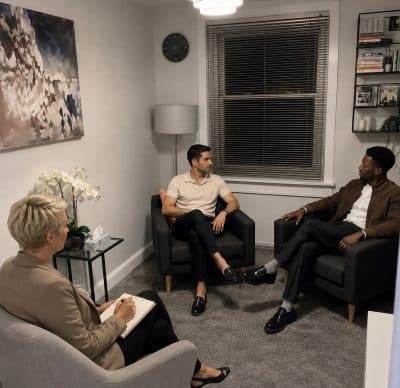
In the Therapy Room
Therapy is not outside these assumptions.
A therapist may expect eye contact, facial responsiveness, emotionally familiar language or visible reassurance that the relationship is working. An autistic client may look away to think, describe an intense experience in an even voice, smile while distressed or need silence before they can answer.
If the therapist confuses expected expression with emotional truth, the client may be described as detached, resistant, avoidant or lacking insight. The therapist may push for feeling words, intensify their own expressiveness or attempt to repair a rupture the client did not experience.
The client then becomes pressured or shuts down — and their response is used to confirm the original interpretation.
A neurodivergent-affirming therapist treats their impression as information to examine, not a diagnosis:
“I notice I am reading your expression as discomfort. I may be wrong. What, if anything, is happening for you?”
Correction must be genuinely possible. The words “tell me if I’m wrong” mean little if disagreement is later reframed as defensiveness.
Therapeutic skill is not demonstrated by reading a client perfectly. Nobody can. It is demonstrated by holding interpretations lightly, noticing power and allowing the client’s answer to change the formulation.
What Genuine Acceptance Can Look Like
Accepting autistic people as whole does not mean pretending that every interaction works, abandoning boundaries or excusing repeated harm. It means beginning with the person rather than with a compulsory performance of normality.
It can look like:
– asking what an expression means rather than announcing it;
– describing observable behaviour separately from inferred emotion or motive;
– believing that emotional presence can exist without conventional display;
– making communication more explicit instead of demanding intuitive social translation;
– allowing pauses, movement, looking away and different vocal rhythms;
– discussing impact without overwriting intention;
– recognising the effort and cost involved in masking;
– sharing the work of cross-neurotype understanding;
– remaining open to correction, especially when holding professional or relational power.
Most of all, it means understanding that unfamiliarity is not misconduct.
A person should not have to rearrange every visible part of themselves before their humanity becomes legible.
How Neurodivergent-Affirming Therapy Can Help
Neurodivergent-affirming therapy can offer a space to examine years of being misread without turning the autistic person into a problem to correct.
Therapy may help you:
– distinguish your own emotional experience from interpretations repeatedly placed upon you;
– explore alexithymia and bodily signals without forcing premature certainty;
– understand the function and cost of masking;
– develop language for correcting misunderstandings and naming impact;
– identify which adaptations are genuinely useful and which require self-erasure;
– create more explicit, consent-based communication in relationships;
– rebuild trust in your perceptions, limits and needs.
For couples, therapy can slow the moment in which expression becomes accusation. It can help both partners separate what was seen, what was assumed, what was felt and what is needed next — without requiring either person to surrender their experience.
Support for Differences in Communication
Your face is part of how you move through the world. It is not a confession written for other people to decode.
You may be deeply moved without looking moved in the expected way. You may be concentrating rather than angry, caring rather than performative, overwhelmed rather than rejecting. You may also be uncertain and need time before an emotion has words.
None of this makes another person’s response irrelevant. Relationships require us to care about impact, clarify misunderstanding and repair harm where we can.
But care does not require surrendering authorship of your inner life.
Perhaps genuine acceptance begins here: not with learning to read every autistic expression correctly, but with releasing the belief that any human face can be read with certainty.
Not forcing familiarity.
Not demanding performance.
Allowing the whole person to arrive.
At Leone Centre, our therapists offer neurodivergent-affirming individual, couples and family therapy in London and online.

You can learn more about Olena Baeva’s approach and book an online appointment, or meet our team of therapists.
- About the Author
- Latest Posts
Olena specialises in supporting <a href=”https://www.leonecentre.com/therapy-issues/neurodivergent-affirming-therapy/”>neurodivergent</a> clients, partners of neurodivergent people, and those exploring Gender, Sexual and Relationship Diversity (GSRD) and Ethical Non-Monogamy (ENM).