

8 Practical Steps to Rebuilding Trust in a Relationship After Betrayal or Infidelity

In a relationship, trust can be significantly damaged by infidelity, dishonesty, secrecy, broken promises or repeated disappointments.
The process of rebuilding trust is possible, but it takes time, patience, honesty and a genuine willingness to understand what has happened. To rebuild trust in a relationship, honesty, consistency, and commitment need to be demonstrated.
For the person who has been betrayed, they may experience anger, sadness, anxiety and uncertainty, while the person responsible may struggle with guilt, shame and the fear of losing the relationship.
For some couples, the process leads to a stronger and more understanding relationship. However, for other couples, they may recognise that moving forward separately is the healthier decision.
In this article, we explore why trust breaks down, how betrayal affects relationships and the practical steps couples can take to begin rebuilding trust and emotional connection.
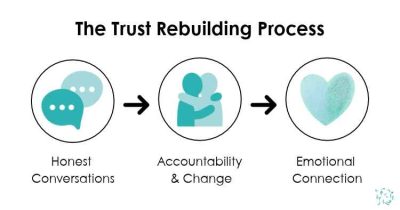
5 Key Takeaways: What You Need to Know About Rebuilding Trust
- Trust is rebuilt through consistent actions, honesty and accountability rather than promises alone.
- The person who has broken trust needs to acknowledge the impact of their behaviour and take accountability, as well as demonstrate a genuine commitment to change.
- The person who has experienced betrayal needs time and space to process their emotions without being pressured to forgive or move on.
- Open communication, appropriate transparency and mutually agreed boundaries can help restore emotional security. Couples counselling can help partners understand what has happened, improve communication and explore whether rebuilding the relationship is possible.
- Rebuilding trust can take time and setbacks do not necessarily mean that repair is impossible.
What Does It Mean When Trust Is Broken in a Relationship?
Trust within a relationship involves much more than believing that a partner will remain faithful. It encompasses honesty, reliability, emotional availability, respect and the confidence that each person will honour the agreements and boundaries they have established together.
When we trust someone, we generally feel able to be ourselves without constantly questioning their intentions or worrying about what they might be hiding. We can depend on them, share our feelings and feel confident that they will treat our vulnerabilities with care.
This sense of security can disappear when trust is broken; even everyday interactions may begin to feel tense or uncertain.
There are several ways in which trust can be damaged in a relationship, including:
- Infidelity and physical affairs
- Emotional affairs
- Lying and dishonesty
- Secrecy
- Emotional betrayal
- Broken boundaries
How Does Betrayal Affect a Relationship and the People Involved?
Betrayal can affect both partners emotionally. When we understand these different emotional responses, couples can approach the process of rebuilding trust with greater patience and awareness.

The emotional impact on the betrayed partner
Betrayal can affect us very deeply, not only affecting trust and confidence in the other person but also affecting confidence in one’s self and one’s own perceptions and judgement.
The partner who has been betrayed may experience the following:
- Shock and disbelief: They may have difficulty accepting what has happened, particularly when the relationship previously felt secure.
- Anger and resentment: Feelings of hurt about the betrayal and the decisions that led to it.
- Anxiety and uncertainty: Worry about whether further dishonesty will occur or whether the relationship can recover.
- Intrusive thoughts: Repeatedly thinking about what happened, questioning events or mentally revisiting conversations.
- Loss of confidence and damaged self-esteem[i]: Doubting their own judgement, attractiveness or ability to recognise dishonesty.
- Hypervigilance: Becoming increasingly alert to changes in behaviour, communication or routine.
- Difficulty with intimacy: Feeling uncomfortable with physical closeness or struggling to experience emotional connection.
What does the research say about betrayal?
Research shows that social pain (like betrayal) relies on some of the same neural regions that process physical pain[ii]. Betrayal can produce life-altering changes and “the effects of a catastrophic betrayal are most relevant for anxiety disorders, and OCD and PTSD in particular”.
The memories or thoughts of a betrayal can also be stored differently in the brain. “Traumatic memories may become fragmented, overly vivid, or intrusive, making it difficult to process and move past the experience”.
It can also affect our belief systems and how safe we experience other people and the world. You may have previously held the belief that people are generally trustworthy or that you can predict others’ behaviours, or that relationships are secure. Betrayal shatters these assumptions, causing anxiety, mistrust in the world, or form new harmful beliefs about people and the world.
These responses help us to understand why betrayal feels painful to the person experiencing it.
The emotional experience of the partner who broke trust
The person responsible for the betrayal may also experience complicated emotions, including guilt, shame, regret and fear of losing the relationship.
They may want to repair the damage quickly, particularly if they feel deeply remorseful. However, they may also become defensive or frustrated when their partner continues to revisit what happened.
The person who broke trust needs to recognise that their partner’s recovery may take considerably longer than they expect. Demonstrating patience, accepting difficult conversations and remaining emotionally available are important parts of taking responsibility.
How betrayal changes the relationship
Betrayal can change the dynamic between partners. Conversations may become more difficult, affection may decrease and everyday interactions may feel very tense and less natural.
Some couples may need time and space apart or find it difficult to be around one another. They may feel emotions that the other partner isn’t able to understand or support them with.
Even when both partners want to repair the relationship, they may have very different experiences of what recovery involves.


Can Trust Be Rebuilt After Betrayal?
Yes, some relationships can recover from betrayal, although this depends on the circumstances and the willingness of both partners to engage in the process.
Rebuilding trust is generally more achievable when the person responsible acknowledges what has happened, demonstrates genuine remorse and makes sustained changes to their behaviour.
There are several important factors that can influence whether trust can be rebuilt:
- Honest acknowledgement: The person responsible needs to recognise the betrayal without minimising it or shifting the blame.
- An end to ongoing deception: Rebuilding trust means being loyal and ending any further lies or deception.
- Consistent accountability: A commitment to loyalty and emotional connection needs to be demonstrated through actions over time.
- Emotional openness: Both partners need opportunities to express their feelings and understand one another.
- Mutual willingness: Rebuilding a relationship requires both partners to participate in repairing the connection, rather than one person carrying the responsibility for repair.

Recovery can be much harder where betrayal is repeated, dishonesty continues or responsibility is avoided.
Ultimately, reconciliation is not always the right outcome. Therapy can help couples establish whether trust can realistically be rebuilt or whether separation is a healthier way forward.
How to Rebuild Trust in a Relationship: Eight Practical Steps
Rebuilding trust requires more than deciding to put the past behind you. It involves developing new patterns of communication and behaviour that gradually restore confidence and emotional security.
A 2025 systematic review by Giacobbi and Lalot[iii] identified several important themes involved in repairing trust within intimate relationships, including: “proactive transparency, active monitoring, remorse and accountability, shared activities and clear communication of reasons for the betrayal.”
These findings reinforce the importance of honesty, responsibility and consistent efforts to rebuild emotional security.

The following steps can help couples begin this process.
-
Acknowledge What Has Happened and Its Impact
An important first step is recognising the nature of the betrayal and understanding how it has affected the relationship.
The person responsible needs to acknowledge their actions without making excuses, minimising the impact or suggesting that their partner should simply move on.
For example, saying “I understand that my dishonesty has affected your ability to feel safe with me” demonstrates a greater awareness of the consequences than simply saying “I’m sorry you are upset”.
Acknowledgement also involves allowing the other person to express their feelings without immediately becoming defensive.
Note: There is a difference between exploring the difficulties that already may have existed within the relationship and accepting responsibility for a specific act of betrayal. Responsibility for choosing to lie, deceive, or break an agreed boundary belongs to the person who made that choice.
-
Allow Time for Emotional Processing
We often want to resolve the situation quickly when we’re experiencing relationship issues. However, emotional recovery cannot be rushed.
The betrayed partner may need time to understand what has happened, ask questions and work through feelings of anger, sadness or uncertainty.
It is important not to place expectations on them to forgive, forget or return to normal within a particular timeframe.
Sometimes, the betrayed partner may need to revisit the same concerns more than once. This does not necessarily mean they are unwilling to move forward. It may reflect an ongoing attempt to make sense of an experience that has fundamentally changed their understanding of the relationship.
Individual therapy can be useful to process each partners’ emotions outside of couples therapy.
“Clients often tell me they feel genuinely held in mind throughout our work together. My approach is warm, compassionate, and collaborative. I believe meaningful change happens when people feel genuinely seen and accepted, and when difficult experiences can be explored with curiosity and compassion rather than self-blame.”
– Holly Roberts, Individual and Couples Therapist at Leone Centre
-
Establish Honest and Open Communication
Communication is essential when rebuilding trust, but conversations following betrayal can be particularly difficult. One partner may fear causing more upset, while the other may want answers or reassurance.
Both partners should try to communicate constructively in the following way:
- Listen without immediately interrupting or defending themselves.
- Express feelings honestly rather than relying on accusations.
- Ask questions when something is unclear.
- Acknowledge the other person’s emotional experience.
- Avoid using previous disagreements to dismiss current concerns.
- Agree to pause conversations when emotions become overwhelming.
For example, saying “I feel anxious when I don’t know where things stand between us” may encourage a more constructive conversation than saying “You clearly can’t be trusted”.
This does not mean avoiding difficult questions or suppressing legitimate concerns. Rather, it means finding ways to discuss painful experiences that allow both people to be heard.
-
Take Responsibility and Demonstrate Accountability
Beyond an apology, genuine accountability involves demonstrating a commitment to doing things differently.
This may involve:
- Being honest, even when conversations are uncomfortable.
- Answering reasonable questions about what happened.
- Ending behaviour that has undermined the relationship.
- Being consistent and reliable.
- Acknowledging the consequences of past actions.
- Showing patience when the other person experiences difficult emotions.
- Making meaningful changes to prevent similar behaviour in the future.
The person who has broken trust should also be willing to explore why they made certain decisions and what needs to change within themselves.
Understanding the reasons behind behaviour is important, but it should not become a way of excusing it.
Trust is gradually restored when words and actions become consistent over time.
-
Agree on Boundaries and Appropriate Transparency
It is important to re-establish the boundaries and expectations within their relationship.
This may involve discussing contact with other people, social media, communication, privacy, financial matters or expectations around time spent together.
For example, a couple recovering from infidelity may agree that communication with a particular person needs to end, or that there should be greater openness about situations that previously involved secrecy.
However, transparency should be mutually discussed and proportionate to the circumstances.
There is an important distinction between agreed openness and controlling behaviour. Requiring unrestricted access to a partner’s devices, monitoring their movements or demanding constant proof of their whereabouts can create further difficulties rather than establishing genuine trust. Both people should feel respected and emotionally secure.
-
Rebuild Emotional Connection Through Small, Consistent Actions
Trust is often restored through everyday experiences rather than grand gestures.
Keeping promises, following through on commitments, making time for one another and showing consideration can gradually help rebuild confidence.
For example, if a partner says they will call at an agreed time, doing so consistently demonstrates reliability. Remembering something important to the other person or making an effort to spend meaningful time together can also help restore a sense of connection.
These actions may appear small, but their significance lies in their consistency.
It is also important to recognise that emotional connection cannot be forced. Both partners need opportunities to reconnect at a pace that feels comfortable and appropriate.
-
Gradually Restore Intimacy and Closeness
Betrayal can affect emotional and physical intimacy.
The person who has been hurt may feel uncomfortable with affection, sexual contact or physical closeness. They may struggle with feelings of rejection, comparison or uncertainty about their partner’s feelings.
For others, physical intimacy may provide a sense of reassurance, although it does not necessarily resolve deeper emotional difficulties.
It is important not to treat physical intimacy as proof that forgiveness has occurred or that trust has been restored.
Rebuilding intimacy may involve spending time together, expressing affection, sharing experiences and gradually becoming more comfortable with vulnerability.
Both partners should respect each other’s boundaries and recognise that emotional and physical closeness may return at different stages.
-
Seek Professional Support When Needed
Sometimes, couples find it difficult to rebuild trust without additional support.
Research by Atkins et al. (2005) explored the outcomes of behavioural couples therapy for couples affected by infidelity. Their findings suggested that: “couples who had an affair and who revealed this affair prior to or during therapy showed greater improvement in satisfaction than noninfidelity couples.”[iv]
Repeated arguments, defensiveness, emotional withdrawal and ongoing anxiety can make it difficult to have the conversations needed to repair the relationship.
A couples therapist can provide a supportive environment in which both partners can explore what has happened, understand their emotional responses and identify more constructive ways of communicating.
Learn more about our experienced couples therapists at Leone Centre:
https://www.leonecentre.com/about-us/meet-our-team/
Therapy can also help couples examine underlying relationship difficulties, establish boundaries and consider whether rebuilding the relationship is possible.
“I help couples build practical communication skills, cultivate empathy, and address challenges like infidelity, conflict, intimacy issues, and life transitions. This can equip couples to face challenges as a team.
I take an integrative approach for individuals, blending Person-Centred Therapy, CBT, Attachment Theory, and Narrative Therapy to process past trauma, break unhelpful patterns, and support resilience, including neurodiversity-affirming practices.
In all cases, I create a compassionate, collaborative space grounded in trust and hope for a brighter future.”
- Nicky Wildin, Couples and Individual Therapist at Leone Centre

Importantly, professional support does not have to be about saving the relationship at all costs. It can also help individuals and couples understand what they need in order to move forward, whether together or separately.
How Do You Know If Trust Is Being Rebuilt?
Rebuilding trust can sometimes feel difficult to measure, however, there are several signs that a relationship may be moving towards greater security and confidence.
These include:
- Your partner’s actions increasingly match their words.
- Difficult conversations become more constructive.
- Both partners feel increasingly comfortable expressing their concerns.
- There is less need for constant reassurance.
- Boundaries are understood and respected.
- The person responsible can acknowledge the impact of their behaviour without becoming defensive.
- Emotional and physical closeness gradually returns.
- Both partners feel more confident discussing future plans.
It is important to remember that occasional feelings of doubt do not necessarily mean that trust has not improved.
How Long Does It Take to Rebuild Trust in a Relationship?
There is no universal timeframe for rebuilding trust. Some couples may begin to feel more secure after a period of sustained effort, while others may find that recovery takes considerably longer.
What If You’re Struggling to Forgive Your Partner?
Forgiveness and reconciliation are not the same. You may eventually forgive your partner without choosing to remain in the relationship, or decide to work towards rebuilding the relationship while still processing feelings of hurt and anger.
It may help to consider what you need to feel emotionally secure, whether those needs can be met and whether continuing the relationship feels right for you.
Professional support can help you process your emotions and decide how best to move forward.
When Should You Consider Relationship Counselling After Betrayal?
Relationship counselling can help couples navigate the impact of betrayal, improve understanding and explore whether trust can be rebuilt.
It may be particularly helpful when:
- Conversations about the betrayal repeatedly lead to conflict.
- One partner struggles to take responsibility.
- The betrayed partner continues to experience significant anxiety or uncertainty.
- Couples disagree about boundaries and expectations.
- Emotional or physical intimacy has become difficult.
- Both partners want to rebuild trust but do not know where to begin.
- One or both partners are unsure whether they want to continue the relationship.
What happens in couples counselling after betrayal?
A couples therapist can help partners understand the impact of what has happened and explore the emotional and relational difficulties that have developed.
This may involve:
- Understanding the breach of trust: Exploring what happened, how each person experienced it and why it has affected the relationship.
- Improving communication: Helping partners express difficult feelings, listen more effectively and move away from repeated patterns of accusation and defensiveness.
- Developing accountability: Exploring what responsibility involves and identifying the behavioural changes needed to begin restoring confidence.
- Establishing boundaries: Helping couples agree on realistic expectations around honesty, communication, privacy and emotional availability.
- Exploring the future: Supporting couples in considering whether they want to rebuild their relationship and what this would involve.
Individual counselling can also be valuable, particularly when someone needs space to process the emotional impact of betrayal or consider their options independently.

Please note: where there is abuse, coercive control, intimidation or fear for personal safety, specialist individual support should take priority. Joint counselling may not be appropriate in these circumstances.
Couples Therapy at Leone Centre: Helping Couples to Rebuild Trust
At Leone Centre, we have a team of highly experienced and qualified couples therapists who offer couples therapy both in-person in London and online worldwide.

Our hand-chosen team of therapists have extensive experience working with couples who are looking to rebuild trust after betrayal or infidelity.
For couples who wish to rebuild their relationship or those who are unsure if they want to remain togehter, therapy can help create a safe space for difficult conversations, develop greater understanding and explore practical ways to understand feelings and consider your options.
Every relationship is different, and there is no single approach that works for everyone, which is why our couples therapists are trained to use an integrative approach, adapting to each couple and individual in the room.
If trust has been damaged in your relationship and you would like support in understanding what to do next, you can learn more about our therapists here:
https://www.leonecentre.com/find-a-therapist/
Or call our friendly team for support on 020 3930 1007.

Frequently Asked Questions About Rebuilding Trust in a Relationship
How long does it take to rebuild trust after cheating?
There is no fixed timeframe for recovering from infidelity. The time involved depends on the circumstances, the extent of the betrayal, whether dishonesty has continued and how both partners approach recovery. Trust generally develops through repeated experiences of honesty and reliability rather than through a single apology or conversation.
Can a relationship survive infidelity?
Some relationships recover after infidelity and go on to develop greater understanding and communication. Others do not. The outcome depends on the circumstances, the willingness of both partners to address what has happened and whether the person responsible is prepared to demonstrate meaningful change. Couples counselling can help people explore whether reconciliation is possible.
How can I prove to my partner that I have changed after betraying their trust?
Change is demonstrated through consistent behaviour rather than promises. This involves taking responsibility, being honest, respecting boundaries, listening to your partner’s concerns and following through on commitments. It is also important to accept that your partner may need time before they feel confident in the relationship again.
Why can’t I stop thinking about my partner’s betrayal?
Repeated thoughts about betrayal can be an understandable response to uncertainty and emotional distress. You may be trying to make sense of what happened, understand whether you can trust your partner again or identify whether there are further concerns. If these thoughts are affecting your everyday wellbeing, individual counselling may help you process the experience.
Should I forgive my partner after they have betrayed me?
Forgiveness is a personal decision and should never be forced. It is also different from reconciliation. You may eventually decide to forgive someone without remaining in the relationship. What matters is taking the time to understand your feelings, recognise your needs and decide what is right for you.
Can couples counselling help after betrayal?
Yes. Couples counselling can help partners explore the impact of betrayal, improve communication, establish boundaries and consider what rebuilding the relationship would involve. A therapist can provide a supportive environment for difficult conversations and help couples understand whether they are both willing and able to work towards reconciliation.
Can trust become stronger after a relationship has experienced betrayal?
Some couples find that working through a breach of trust leads to greater understanding, more honest communication and clearer relationship boundaries. However, this is not an automatic outcome. It requires sustained effort, mutual willingness and meaningful changes in behaviour. The aim should be to develop a healthier relationship, rather than assuming that experiencing betrayal will make a relationship stronger.
References
Irvine, T. J., et al. (2024). A pilot study examining the effectiveness of Gottman Method Couples Therapy over treatment-as-usual approaches for treating couples dealing with infidelity. The Family Journal, 32(1). https://doi.org/10.1177/10664807231210123
[i] Rachman, S. (2010). Betrayal: A psychological analysis. Behaviour Research and Therapy, 48(4), 304–311. https://doi.org/10.1016/j.brat.2009.12.002
[ii] Eisenberger, N. I. (2015). Social pain and the brain: Controversies, questions, and where to go from here. Annual Review of Psychology, 66, 601–629. https://doi.org/10.1146/annurev-psych-010213-115146
[iii] Giacobbi, M., & Lalot, F. (2025). Unpacking trust repair in couples: A systematic literature review. Journal of Family Therapy, 47(1), e12483. https://doi.org/10.1111/1467-6427.12483
[iv] Atkins, D. C., Eldridge, K. A., Baucom, D. H., & Christensen, A. (2005). Infidelity and behavioral couple therapy: Optimism in the face of betrayal. Journal of Consulting and Clinical Psychology, 73(1), 144–150. https://doi.org/10.1037/0022-006X.73.1.144